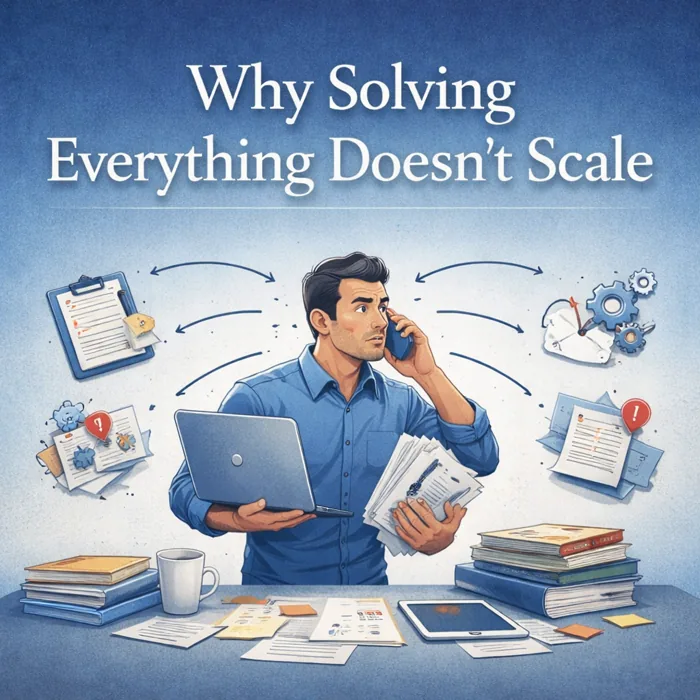
When helping feels faster
For a long time, solving problems myself felt like the most efficient option. Explaining the context, reviewing options, and talking through a solution often sounded like more work than just doing it. Sometimes it was. And sometimes, after all that discussion, the problem still came back to me because the person wasn't able to resolve it. That was frustrating. There was also the feeling that people didn't fully understand the issue yet. Not because they weren't capable, but because they didn't have the same context. At that point, stepping in felt justified. So I kept helping. It felt practical. It kept things moving. I used to read that speed as proof I was helping the team. Over time, I started seeing that I was also training the system to route decisions back through me.
When efficiency starts to fragment
Over time, that efficiency started to break down. Not all at once. Slowly. I was helping the team, trying to finish my own work in the sprint, and staying involved in decisions. Each of those made sense on its own. Together, they stretched my attention thin. I started noticing that I wasn't particularly good at any of them anymore. That's when a pattern became clearer.
People were coming to me more and more. Sometimes for things they could have answered themselves. Sometimes to help someone else instead of helping directly. I had become the shortest path. Not intentionally. Just by being available and responsive. That's when it became obvious that this wasn't about working harder or helping faster. It was about scale. As long as I stayed in the middle, everything flowed through me. Something had to give.
Changing how I help
Letting go didn't mean disengaging. It meant slowing the moment where I stepped in. Instead of answering right away, I started asking what people had already looked at. What they were thinking. How they would approach the problem. That shift was deliberate. It didn't remove my involvement, but it changed its shape. Helping became less about providing answers and more about refining reasoning. At first, it felt slower. Sometimes uncomfortable.
This didn't make things cleaner. People started making more decisions, which was the point. But that also meant more discussions afterward. More debates. More brainstorming with people who didn't agree with a given direction. Often, they still wanted acknowledgment. Not permission, but confirmation that their reasoning made sense. That takes time. The difference is that decisions no longer depend on me being available. Things can move forward even when I'm not there, or when I'm on vacation.
This shift didn't free up my calendar. What it changed is where the system depends on me. I spend less time solving problems in isolation. More time creating alignment, reviewing thought processes, and helping people think through trade-offs. It's not faster. But it scales. And over time, it makes the team less dependent on me being in the middle of everything.
- Patrick