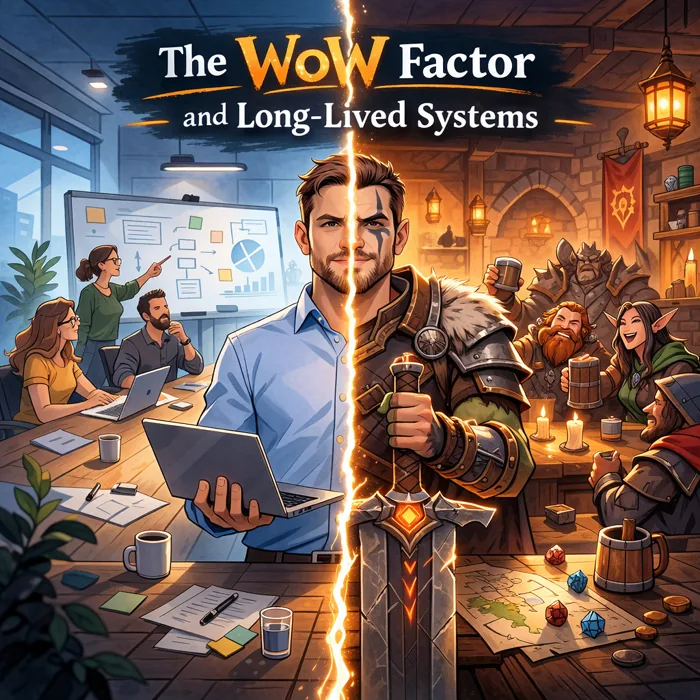
I have been playing World of Warcraft since its early days, and over time I started looking at it less as a game and more as a long-running system shaped by tradeoffs that feel familiar at work.
Two parallels stand out in particular: how a product can evolve for decades without collapsing under accumulated complexity, and how groups form, perform, and change as expectations rise. Both feel familiar from where I stand on the engineering side.
Product Longevity and Accumulated Complexity
World of Warcraft has been running for more than 20 years. Most MMORPGs launch strong and gradually lose momentum, retaining only a dedicated core of players. Blizzard managed to keep this one alive through multiple expansions, redesigns, acquisitions, and internal restructurings.
In the early years, adding features was relatively straightforward. The original game had obvious room to grow. Each expansion introduced new systems, mechanics, classes, and progression paths. For players who had already explored everything available, that complexity felt like depth.
Over time, however, the accumulation became visible. For new players, the entry barrier increased. Creating a character meant navigating layers of systems built over years: skill trees, professions, currencies, endgame mechanics, and optimization paths. External guides became almost mandatory.
Complexity eventually stops feeling like richness and starts feeling like friction. There is also a structural cost. As systems grow, development slows. What once required a contained change now touches multiple subsystems. New features take longer to ship. From the outside, innovation can appear slower, even if the team is working harder.
Meanwhile, competitors operating on simpler foundations can move faster. They ship features quickly because they carry less historical weight. Complexity becomes both an advantage and a constraint.
Blizzard did not rely only on expansions to stay relevant. They built recurring communication loops around the product. BlizzCon became a ritual. Even when an expansion was far away, players had visibility into what was coming next, and anticipation became part of the engagement model.
They published frequent developer updates and detailed patch notes explaining design decisions. Sometimes those posts acknowledged mistakes. Sometimes they explained why feedback was incorporated - or why it was not. They also introduced Public Test Realms where players could try changes before release. Feedback happened before full deployment. It did not eliminate friction, but it reduced surprises.
They experimented with structured feedback groups like the Community Council. Forums remained active for years. Surveys were sent out randomly. Social channels and livestreams kept conversation alive between major releases. Battle.net itself became more than a launcher; it evolved into a social infrastructure connecting players across games, reinforcing identity and presence.
None of these tools guaranteed success. Some expansions were still poorly received. Some systems were introduced and later removed. At times the story felt rushed or disconnected. Direction shifts likely reflected internal leadership changes as much as player feedback.
But what stands out is the rhythm: ship, communicate, test, adjust, repeat. Longevity did not come from avoiding missteps. It came from keeping the loop active.
Observing from an Engineering Lens
From my position in engineering, I tend to see accumulation in structural terms. Over the years, we have also added feature after feature in response to business demands and market opportunities. Some customers have been with us a long time. Others sign up and leave quickly. We extended the system as required.
Earlier in my career, I tended to read slower delivery as a sign that teams were losing execution discipline. Over time, I started seeing it differently: a meaningful share of that slowdown comes from accumulated structure, not reduced effort.
In the same way WoW kept stacking systems to serve different types of players, we kept layering flows to serve different segments, partners, and operational constraints. Rarely does an old path disappear when a new one is introduced. Most of the time, both stay alive because someone still depends on the older behavior. The result works, but it is undeniably more complex than it once was.
With complexity comes slower delivery. Dependencies multiply. The cost of change rises. Releasing something new requires navigating what already exists. A change that looks local on paper can involve billing, reporting, permissions, data migration, and support processes before it is safe to ship.
This is also where similarity with WoW becomes clearer: the visible feature is only the tip of the work. Most effort goes into preserving continuity for people already inside the system. Existing customers expect stability, while new customers expect simplicity. Trying to satisfy both at once is where friction accumulates.
The harder question is whether we have enough structured feedback loops. Not just support tickets or analytics, but mechanisms that let us detect friction earlier, while a change is still cheap to adjust. We are often good at reacting after impact is measurable, but less disciplined at creating anticipation before rollout.
In practice, that gap shows up in familiar ways: teams discover hidden dependencies late, support learns about edge cases after launch, and simplification initiatives are postponed because short-term delivery pressure wins. None of this is dramatic on its own, but over time it compounds.
At some point, simplification becomes necessary. That may mean reducing surface area, consolidating flows, removing partial solutions, or rethinking assumptions that were valid a few years ago but no longer hold. Later, growth pressures push toward expansion again. It feels less like a failure and more like a cycle: expand, accumulate, simplify, and expand again.
From Systems to Groups
The second parallel is about people rather than features. As time passes in a game like World of Warcraft, people naturally regroup around similar goals, pace, and interest in more challenging content. Guilds become more than raid rosters. They are places where players exchange what they are enjoying, share what they are learning, and help each other progress through crafting, gathering, and practical advice.
That cooperation is not always formal, but it creates real group dynamics. In practice, joining a guild is easy, while participating in serious group content is not. When a guild attempts more challenging content, expectations shift quickly. Performance is scrutinized, preparation becomes mandatory, and players invest time and in-game currency in gear, enchantments, consumables, and studying encounter mechanics. Players are expected to know their role and execute it reliably.
Some guilds accept slower progression, while others are more demanding. If performance is not there, you may be benched. If you are repeatedly late, someone else may take your place.
Loot distribution adds another layer of tension. Rewards can be allocated by need, seniority, randomness, or leadership decision, and no model feels perfectly fair to everyone. When someone invests significant time and effort, it is natural to feel the group owes something in return.
The parallel with work is difficult to ignore. On important projects or releases, expectations tighten in similar ways: people are expected to know the technology, prepare well, and deliver reliably. If they cannot, they may be replaced, and resource allocation decisions - tools, budgets, opportunities - can create the same kind of friction. Tenure does not always guarantee priority, so perceived fairness becomes part of culture. Investment creates expectation.
Over time, groups accumulate more than members. They accumulate expectations: informal norms about effort, fairness, reliability, and what people feel they have earned.
In raids, that accumulation shows up when pressure rises: attendance is tracked, mistakes are remembered, and reward decisions can quickly become emotional. The workplace version is not that different. Deadlines tighten, reliability becomes visible, and people start interpreting every decision through the lens of recognition and fairness.
In our work environment, we introduced structured reflection to manage that buildup. Team retrospectives gave us a way to step back, review the sprint, and create space where people could raise friction before it became resentment. We then focused on action items we could influence directly as a team. We learned that deciding what the company should do is rarely within our control. Proposing ideas is still useful, but acting on what we directly influence is more realistic, and that discipline matters over time.
I rarely saw equivalent mechanisms in the guilds I joined. People invested serious time and effort, sometimes close to a second job, yet structured reflection on how the group was functioning was uncommon. It remained "just a game," even when expectations and frustrations were real.
That contrast made the parallel clearer for me: both raids and workplace teams face the same social pressure under performance constraints, but strong teams are more deliberate about reflecting, adjusting, and resetting how they work together.
Renewal and Relevance
Out of all the MMORPGs launched over the years, only a few survived this long. World of Warcraft remains one of the rare examples that sustained relevance across generations of players, internal changes, visible missteps, and accumulated complexity.
That raises a broader question: how does a company renew itself over decades? How does it stay relevant to new customers without alienating long-time ones? How does it simplify without appearing to regress, and how does it innovate without collapsing under its own weight?
From where I stand, both systems and groups seem to require the same discipline: accepting that growth introduces weight, that experimentation includes failure, and that periodic reset is necessary. The more interesting question may not be how to avoid complexity, but how to manage it long enough to know when it needs to change.
- Patrick