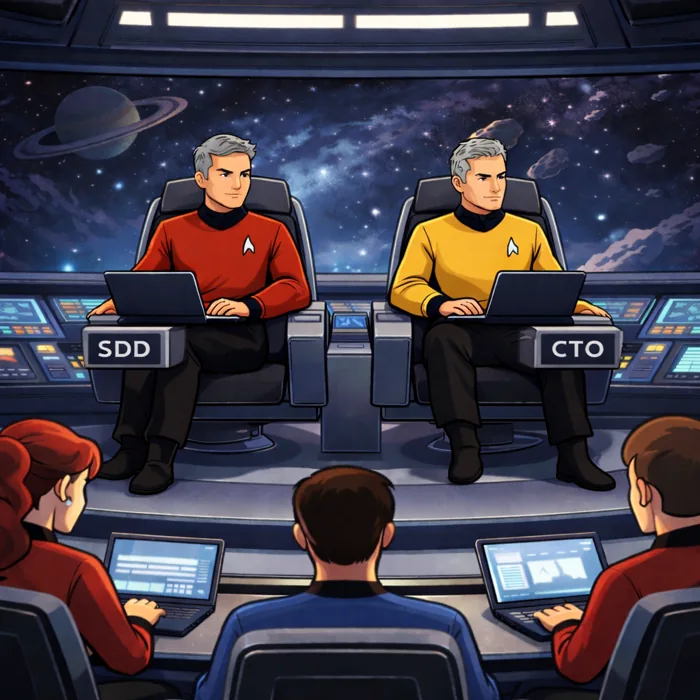
I've spent the last 22 years working at what looks like the same company. That's not entirely true. The company I started with was acquired years ago, but even before that, we were already working closely together in the same domain. In practice, I've spent over two decades in the same ecosystem, watching it evolve from the inside. I started as a developer, learning the ropes. A few years later, I moved into a lead role. When the acquisition happened, we transitioned from our own system to a larger platform. That change kept things interesting. There was always something new to understand, something unfamiliar to adapt to.
Stepping into the unknown
In 2015, I was given the opportunity to move into a Product Owner role. I didn't really know how to do that job. I had worked with Product Owners before, but stepping into the role myself was different. Still, I took the opportunity. I saw it as a chance to learn and to improve how things were done. Like many developers making that transition, I believed I could approach the role differently. It wasn't smooth. I made mistakes. I learned through trial and error. I often had to operate within constraints I didn't fully agree with, while still trying to make decisions that felt reasonable for the team. There was no clear playbook, so I learned mostly on my own, including formal project management training done outside of work.
Three years later, I was asked to step into a Software Development Director role. Once again, I said yes without really knowing what the day-to-day would look like. I remember worrying there wouldn't be enough work to fill my days. That turned out to be very wrong.
The weight of leadership
The role was fuller than anything I had done before. Supporting teams. Reviewing and adapting processes. Aligning engineering work with business goals. Thinking through roadmaps, trade-offs, and long-term direction. Carrying technical concerns in one direction and business constraints in the other. Over time, I realized that much of the job isn't visible. It's about context, communication, and decisions that don't always have a clearly "right" answer. Leadership also comes with weight. You make plans that don't always get executed. You make decisions that affect people you care about. You ask teams to keep systems running while knowing they could be better. You learn to live with imperfect outcomes.
Operating with incomplete information
In recent years, like in many organizations, change has become more constant. Structures evolve. Priorities shift. Decisions are sometimes made at a level far from where the work happens. As a leader, that often means operating with incomplete information while still being expected to provide clarity and reassurance. That part of the job is uncomfortable. What I've learned is that reassurance doesn't come from having all the answers. It comes from helping people stay capable, adaptable, and relevant.
That realization forced a more practical question for me: if I can't control every decision or every shift in direction, what does good preparation actually look like?
Over time, I stopped thinking of preparation as trying to predict every change. I started seeing it as maintaining adaptability, for myself and for the teams I support.
Reframing preparation
For me, that meant reframing preparation away from fear and toward learning. I started paying closer attention to what the market values today, not with the intent to leave, but to stay sharp and keep my own thinking aligned with where the industry is moving.
AI is a good example of that shift. Rather than treating it as something abstract or purely disruptive, I've focused on how tools like AI, agentic workflows, and automation can help in day-to-day work. How they can reduce friction, improve decision-making, and give teams more room to focus on meaningful problems.
I've taken the same approach with my teams. Not by making promises about the future, but by encouraging learning. Making sure people understand how new tools can fit into their daily work. Helping them experiment, stay curious, and build skills that matter beyond any single organization.
I see that as part of my responsibility as a leader.
Stability doesn't mean eliminating uncertainty
I've always leaned toward an empathetic, servant-style approach to leadership. Creating an environment where people can grow, learn, and do good work has always mattered to me. That hasn't changed. What has changed is my understanding that providing stability doesn't mean eliminating uncertainty. Sometimes it simply means helping people build the confidence and skills to navigate it.
Some of that thinking became clearer to me through Simon Sinek's work. Start With Why reinforced that clarity often comes from purpose before process. Leaders Eat Last made me think more intentionally about psychological safety and trust as leadership responsibilities, not side effects.
Those ideas don't remove uncertainty. But they do give me a steadier way to lead through it.
- Patrick